
A label-by-label reading of six names that appear on natural supplements for men sold in Indonesia.
Common ingredients in men's supplements
This page explains the names you keep seeing on men's supplement panels in Indonesia: zinc, vitamin B6, vitamin D, magnesium, maca, and saw palmetto. For each one, we cover what it refers to and how it typically appears on a label, so the panel stops reading like a code.
Health and lifestyle reading only. Food supplements are not a substitute for a varied diet.
Key to the plate
A. Supplement bottles with the panel facing away — the amount per serving is what you are comparing, not the front-of-bottle line.
B. The weekly tray. It is the cheapest way to notice whether a formula actually fits the days you already live.
C. Water. Most mineral and vitamin entries on a men's formula are read next to how you take them, not in isolation.
The shelf itself is narrow by design: retailers stock formulas built around a small set of recognizable ingredients, which is why the same names return across brands and price points.
Why these six names dominate the shelf
Retailers stock formulas built around a small set of recognizable ingredients because shoppers trust panels they can pronounce. That is why the same names recur across brands and price points.
Knowing them individually makes comparison fast. You stop reading a panel as a block and start reading it as a list of familiar parts.
Mineral and vitamin core
Zinc, vitamin B6, vitamin D, magnesium.
Botanical core
Maca and saw palmetto.
Almost every product on our comparison page is some combination of these six.
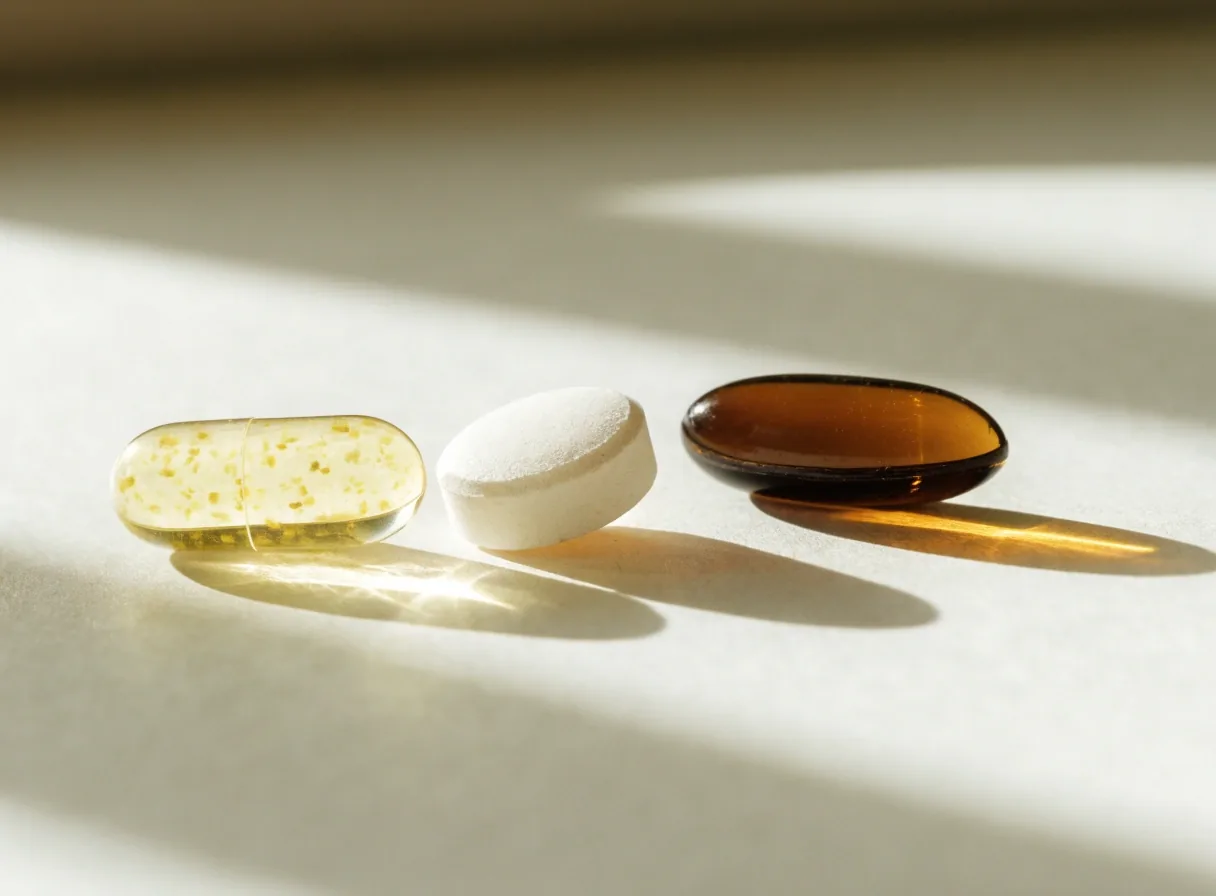
Three formats, one panel logic. Capsules, tablets and softgels are compared on stated amount per serving, not on the shape of the casing.
Zinc + B6
Frequently paired on the same panel line.
Vitamin D + magnesium
Broad-panel entries, often in multivitamins.
Maca + saw palmetto
The two botanicals that carry most formula names.
Zinc and vitamin B6
Zinc is one of the most common minerals in vitamins and minerals for men, often paired with vitamin B6. The pairing is deliberate: the two appear together so frequently that some products are named around it, such as Nutriwell Tri Zinc + Vitamin B6.
How the amount is written
Milligrams per serving, or a percentage of a reference intake.
What "tri" zinc refers to
A blend of zinc forms inside one formula, not a different mineral.
Everyday check before you add one
If you already take a multivitamin, read its zinc line first.
Overlap is the most common beginner mistake in this category. Two products can each look reasonable on their own panel and still repeat the same entry at full strength once you take them side by side.
Vitamin D and magnesium
Vitamin D appears in most men's multivitamins and in some targeted formulas, usually listed in international units or micrograms. It is one of the standard entries on a broad panel, alongside vitamin A and C.
Both are common enough that you can compare products on their stated amounts directly, without needing to decode the naming. The named form of magnesium tells you more about the compound than the marketing copy on the front does.
Where magnesium usually sits
Evening or recovery-positioned products, and mineral blends. On labels it shows up as magnesium citrate, magnesium oxide, or a similar named form.

The evening slot: where magnesium entries most often sit on a broad men's formula.
DHow to read a supplement facts table
The table is where labels become comparable. Start with the serving size at the top, then scan for the ingredients you care about and their amounts. Percentages of reference intake are useful context but not the whole story.
Do this for two products side by side and the differences surface in a minute or two. That is the entire method behind our comparison page.
The fifth tick marks the day being read: a full panel walk-through instead of a front-of-bottle glance.
Serving size
Read this line first. Everything below is scaled to it.
Amount per serving
The number you can actually put two products against.
Other ingredients
Casing, fillers and the format section of the panel.
Ignore front-of-bottle claims while reading the table. The panel does not care about marketing copy, and neither should your comparison.
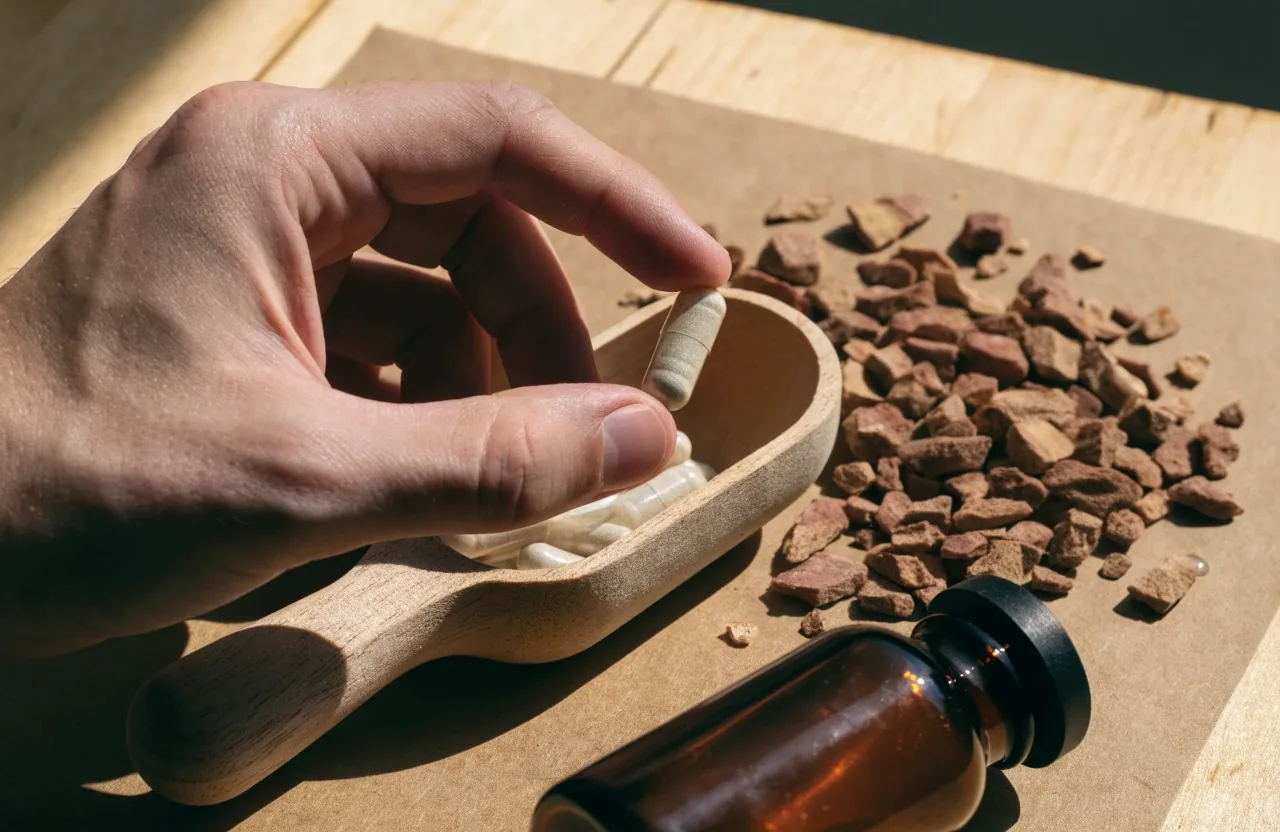
One ingredient, one known quantity: the case for a dedicated maca capsule over a broad blend.
EMaca root
Maca is the most visible botanical in energy and endurance formulas. It appears as a single-ingredient capsule, as with Solaray Maca Root 525 mg, and inside broader performance-oriented blends.
On a label, look for the extract amount and the format. A dedicated maca capsule gives you a known quantity of one ingredient; a blend spreads its panel across several botanicals at smaller amounts.
Which one you want depends on whether you prefer focus or breadth. Our energy and endurance page compares the two approaches directly.
Saw palmetto and botanical blends
Saw palmetto turns up in ingredient-led formulas, including GNC Men's Ultra Saw Palmetto Formula, usually in tablet form. It is one of the botanicals that appears in the product name itself, which tells you it is the headline ingredient.
Blended herbal products sit alongside it, labeled with terms like ekstrak botani or kapsul herbal. These panels list several extracts at once, which makes the headline harder to identify.
Single-botanical panel
One named extract carries the panel.
You can read the amount, the format and the cost per serving without working through a second botanical. Names like saw palmetto in the product title are the brand telling you which ingredient leads.
Blended herbal panel
Several extracts share one line.
Convenient when you want to try a category without picking one botanical. Harder to compare, because several variables move at once and the headline ingredient is not obvious.
If a blend's purpose is unclear from the panel, that is useful information too. Prefer products where you can name what you are taking and roughly how much.
Where ingredient quality shows up in copy
Brands signal sourcing through phrasing: whole food, food-based, naturally derived, standardized extract. Each phrase describes how the ingredient was produced or paired, not how it will feel to take.
Whole-food multivitamins such as MegaFood build their positioning around this kind of language. It is a legitimate differentiator, and it is also a cost factor.
Whole food / food-based
Describes how the ingredient is delivered, usually in a tablet or chewable format.
Naturally derived
A sourcing statement about origin or extraction, not a dosage claim.
Standardized extract
Names a target compound or a ratio so the plant material is more predictable batch to batch.
Read the sourcing language as context, then return to the panel for the numbers. The two together give you the full picture.
When one ingredient formula beats a blend
If you know which ingredient you want, a single-ingredient product is easier to evaluate than a blend. You see the amount, the format, and the cost per serving without distraction.
Blends make sense when you want to try a category without picking a single botanical, or when a brand's combination is convenient. They are harder to compare, though, because several variables move at once.
Neither shape is better. But matching the shape to your question keeps the decision simple, which is what our vitamin formula guide recommends from the start.

The simplest test: can you name what you are taking and roughly how much, without checking the bottle twice?
FQuestions readers send us about ingredient panels
Why do so many men's formulas repeat the same six ingredients?
Because the shelf is built around names shoppers already recognize. Zinc, vitamin B6, vitamin D and magnesium cover the vitamin and mineral side; maca and saw palmetto cover the botanical side. A formula that steps outside those six has to explain itself on the label, which is harder to sell in a shop aisle.
Is a higher number on the panel always the better choice?
No. The useful question is whether the amount fits alongside everything else you already take. A dedicated product with a large zinc line added on top of a multivitamin repeats the same entry, which is the overlap mistake worth avoiding.
What does ekstrak botani mean on a local panel?
It is the Indonesian term for a botanical extract, and it usually signals that the product contains plant material rather than a single isolated mineral or vitamin. On a blended herbal panel the term can cover several extracts at once, so check which one appears first in the ingredient order.
Should I stop taking a multivitamin before adding a dedicated formula?
That is a personal decision, and it is worth speaking with a qualified professional before changing a routine that already works for you. What we can help with is the reading side: compare the panels first, then take the question to someone who knows your situation.
Start with the panel, then pick the formula
Once zinc, B6, vitamin D, magnesium, maca and saw palmetto stop reading like a code, the shelf gets shorter. Take the two panels you are deciding between and read them against these six names before you spend anything.
Bugar Pria
Jl. Gajah Mada No. 135, Miroto, Semarang Tengah, Semarang, 50134
Monday to Friday, 09:00–18:00
Questions about a panel you are holding? Send the ingredient list and we will walk the table with you.